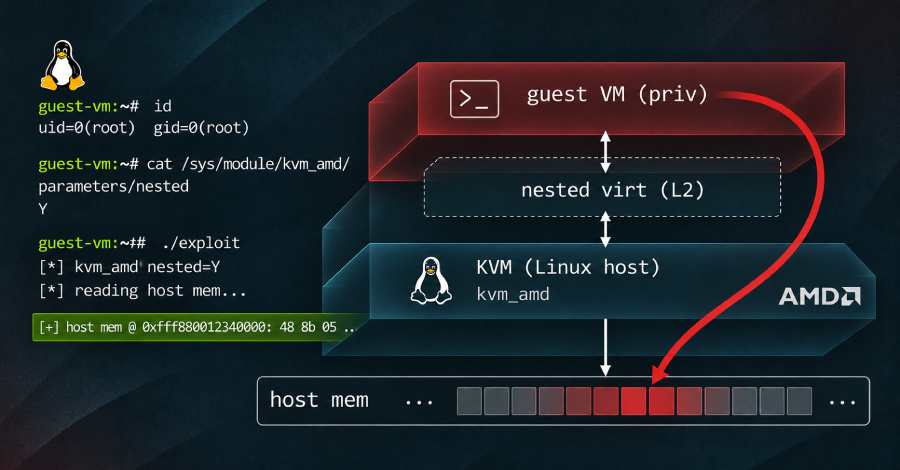
Security researchers have disclosed details on CVE-2026-99312, a high-severity vulnerability within the Linux Kernel-based Virtual Machine (KVM) module. By weaponizing this flaw from inside an unprivileged guest virtual machine, researchers demonstrated the ability to read approximately 127 GB of host memory on a DigitalOcean instance, exposing sensitive host data and adjacent tenant information.
Technically, the issue isolates strictly to hosts running AMD microprocessors and stems from improper validation inside nested paging management within the KVM subsystem. This mapping bug permits a guest to bypass hypervisor memory boundaries and issue unauthorized read requests to physical host memory addresses without triggering immediate access violations.
The ramifications for public cloud infrastructure and multi-tenant hosting providers are severe, effectively dismantling the core tenant isolation guarantee of virtualization. Infrastructure engineers and system administrators must immediately backport relevant kernel patches across all AMD-based virtualization hosts to restore hypervisor integrity.