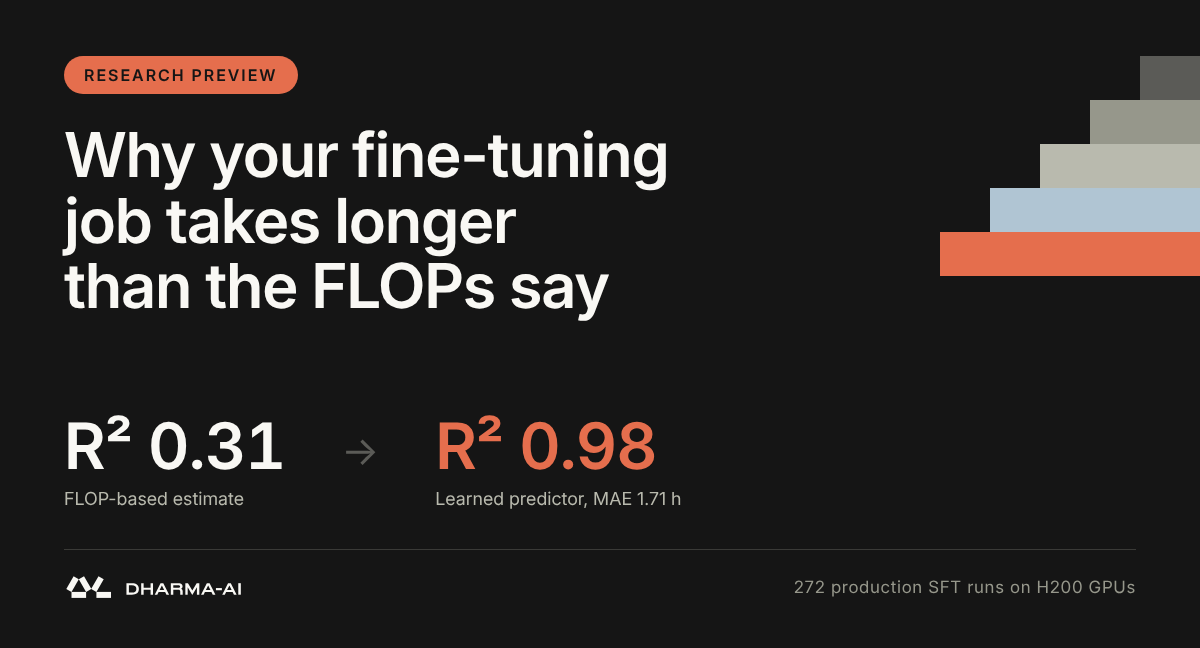
Hugging Face published an in-depth technical analysis addressing a persistent headache for ML platform engineers: why model fine-tuning tasks consistently take longer than estimates derived from theoretical FLOPs (Floating Point Operations). While theoretical calculations assume constant compute-bound saturation, production hardware rarely achieves peak theoretical throughput.
The analysis explains that training pipelines are frequently bound by memory bandwidth (the memory wall) rather than raw matrix compute capacity. Inter-GPU communication overhead during distributed gradient all-reduce operations, unoptimized kernel launch latencies, and irregular sequence padding create significant GPU idle states.
The guide outlines concrete mitigation strategies for engineering teams, including the adoption of FlashAttention, sequence packing to eliminate padding tokens, optimized CUDA memory allocation, and reduced-state optimizers to push real-world execution closer to hardware limits.