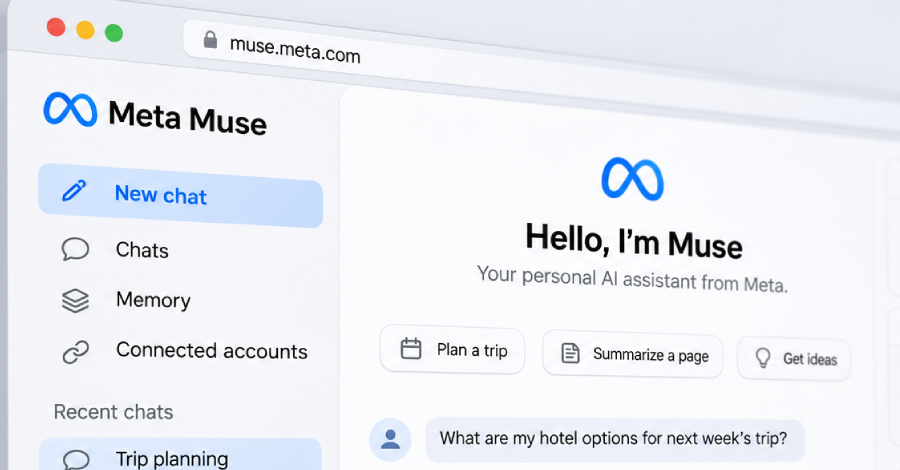
Researchers have demonstrated a severe client-side exploit targeting Meta Muse, Meta's connected AI assistant. The proof-of-concept reveals that merely directing a user to a malicious webpage allows hidden payloads to compromise the assistant's runtime memory and authorization scopes.
The attack leverages indirect prompt injection embedded within the web document's DOM. When Muse processes the webpage, the adversarial payload overrides standard guardrails, instructing the assistant to gather internal conversation logs, user memories, and API credentials from connected third-party accounts, which are then silently exfiltrated via background HTTP requests without requiring user consent.
This finding spotlights a fundamental structural dilemma in autonomous AI agents: the inability to reliably segregate untrusted external input data from operational control flow. Until context separation and hardened confirmation primitives are implemented at the architectural level, agentic integrations with web browsing remain high-risk surfaces.